Trade Cockpit
Internal product design, vehicle trade management
The full case study: from spreadsheets and Slack to a structured trade lifecycle.
From spreadsheets and Slack to a structured trade lifecycle.
Gowago manages vehicles returned after leasing contracts end or are terminated early. Each return starts a trade: vehicle intake, inspection, repair, resale and financial settlement, across four teams.
Trade data was scattered across HubSpot, Google Sheets, Slack and email threads. There was no single place to see the full status of a trade.
Approvals for repairs, invoicing and pricing were informal, error-prone and untraceable. Remarketing, Finance and Logistics coordinated through constant manual messages.
Without structured financial tracking, standing days, break-even prices and margins showed up at the very end of a trade, too late to act on.
In-depth interviews with the Remarketing team to understand daily workflows, pain points and tool usage.
Collaborative workshops to document the exact steps teams follow for each trade type.
An audit of HubSpot properties and spreadsheets to identify the key data points and how they relate across the trade lifecycle.
Early wireframes tested with users to validate lifecycle stages, terminology and the layout of the Trade Cockpit.
Users were unsure which lifecycle stage a trade was in, because there was no shared definition. That led to duplicated effort and missed handoffs between Remarketing and Finance.
A single trade meant switching between HubSpot, Sheets, a partner portal and several Slack threads. People spent more time finding information than acting on it.
Break-even and profit were visible only at the very end. Teams needed an estimated profit and loss earlier, to make informed pricing and repair decisions.
End-of-lease returns involve different entities and workflows than trade-ins. The solution had to support every subtype without becoming overwhelming.
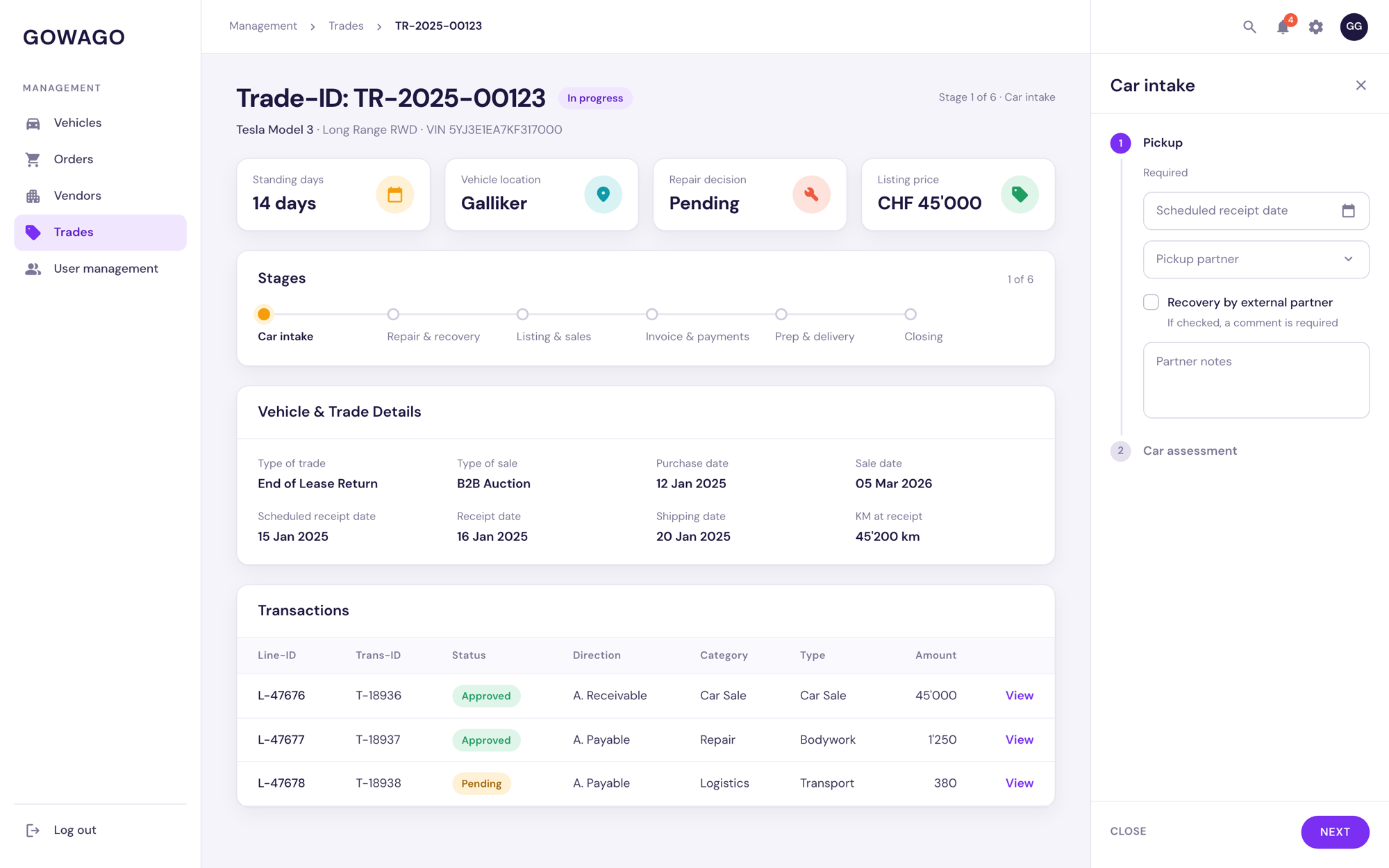
The Trade Cockpit: one screen to manage the entire trade lifecycle, built on a single trade record that connects the vehicle, the leasing contract, the supplier or buyer, the listing and the transactions. Because the complexity was in the workflow logic rather than the visual layout, I prototyped directly in code to test stage progression, lifecycle logic and data relationships.
One source of truth for every trade, replacing fragmented tools with a single lifecycle view across all stages.
Fewer status checks and handoffs across teams. Trade progress is visible at a glance, in real time.
Profit and loss visible at every stage, for earlier and more confident pricing and margin decisions.
The structured data model and lifecycle stages lay the groundwork for rule-based automation.
The main challenge was structuring data and workflows, not just designing interfaces.
Prototyping in code helped validate lifecycle stages before committing to visual design.
A clear data model made it possible to introduce reporting and automation later.